

Is Tea Tree Oil Banned in the EU? What's Changing
Tea tree oil is not banned in EU cosmetics as of November 2026, but its status is changing. The European Union plans to classify it as toxic to reproduction, which normally triggers a ban unless an exemption is granted. The EU's scientific committee considers it safe for adults at up to 2% in shampoo, 1% in shower gel or face wash, and 0.1% in face cream.
Key takeaways
- In November 2023, the Risk Assessment Committee of the European Chemicals Agency recommended classifying tea tree oil as a Category 1B reproductive toxicant.
- On October 30, 2025, the EU Scientific Committee on Consumer Safety (SCCS) found tea tree oil safe at up to 2% in shampoo and 0.1% in face cream, for adults only.
- The same opinion excludes sprays and aerosols and describes tea tree oil as a moderate skin sensitizer.
- The draft regulation that formalizes the classification was notified to the World Trade Organization on November 27, 2025, with application planned 18 months after it enters into force.
- In August 2026, the Australian tea tree industry reported that the text still had not been published in the Official Journal of the European Union.
- In October 2026, the UK Health and Safety Executive (HSE) chose not to propose a CMR classification for tea tree oil in Great Britain for now.
Contents
- Is tea tree oil going to be banned in cosmetics?
- What is tea tree oil and why is it used in cosmetics?
- What tea tree oil concentrations does the EU scientific committee consider safe?
- Why is tea tree oil being classified as toxic to reproduction?
- How does Ouany see essential oils from St Barts?
- Our tips for choosing and using tea tree oil cosmetics
- FAQ
- Sources
Is tea tree oil going to be banned in cosmetics?
Tea tree oil is unlikely to disappear completely from European cosmetics, but it will very probably be restricted. Its upcoming classification as a reproductive toxicant triggers a ban by default. Thanks to a favorable opinion from the EU scientific committee, it could remain allowed at low levels in four product categories for adults.

What EU law says
The EU Cosmetics Regulation bans, in principle, any substance classified as a Category 1A or 1B CMR. A CMR substance is one recognized as carcinogenic, mutagenic or toxic to reproduction.
An exemption is possible if four conditions are met, according to Article 15 of the regulation as quoted by the SCCS: the substance must meet food safety requirements, no suitable alternative may exist, the request must cover a specific use with known exposure, and the SCCS must find it safe. The Commission then has 15 months after the classification to adopt regulatory measures.
A timeline that keeps slipping
The tea tree oil classification is part of the 24th Adaptation to Technical Progress of the CLP Regulation, the EU law governing how chemicals are classified. The draft was notified to the World Trade Organization on November 27, 2025.
According to the consultancy Critical Catalyst, it was due to enter into force 20 days after publication, expected in the first quarter of 2026, and to apply 18 months later. Yet in August 2026, the Australian Tea Tree Industry Association (ATTIA) noted that the text still had not been published. The association was also preparing legal arguments to challenge the classification if it is adopted.
Annex II or Annex III: two possible outcomes
The cosmetics law firm COSlaw sums up the stakes: without a favorable SCCS opinion, a newly classified CMR substance goes into Annex II, the list of banned substances. With a favorable opinion, it can enter Annex III, the list of substances allowed under conditions. For tea tree oil, COSlaw considers the second option more likely, since the SCCS has already set safe concentrations.
What is tea tree oil and why is it used in cosmetics?
Tea tree oil is an essential oil obtained by steam distillation of the leaves and young branches of Melaleuca alternifolia, an Australian tree. Manufacturers use it in anti-dandruff shampoos, products for problem skin, deodorants, soaps and oral care products, according to the European COSMILE database.

An essential oil with a defined composition
An essential oil is a blend of aromatic molecules extracted from a plant, in this case by distillation. Tea tree oil is made up mostly of terpenes, volatile plant compounds.
The international standard ISO 4730:2017 defines its composition. Terpinen-4-ol, its main component, must make up 35% to 48% of the oil, and gamma-terpinene 14% to 28%. The SCCS opinion only applies to oil that meets this standard.
What studies say about the ingredient
The dossier reviewed by the SCCS defended tea tree oil as an antimicrobial and anti-seborrheic agent, meaning one that limits excess sebum and flaking. The opinion cites a 2002 trial by Satchell and colleagues: among 126 participants who used a 5% tea tree oil shampoo for four weeks, 41% saw their seborrheic dermatitis improve.
That 5% level is above the 2% ceiling the SCCS considers safe for shampoo. Seborrheic dermatitis is a skin condition, and diagnosing and treating it is a job for a dermatologist.
How to spot it on the label
On the ingredient list, tea tree oil appears under its INCI name, the international naming system for cosmetic ingredients: "Melaleuca Alternifolia Leaf Oil." The EU CosIng database lists several functions for it, including antioxidant, fragrance and antimicrobial.
What tea tree oil concentrations does the EU scientific committee consider safe?
The EU Scientific Committee on Consumer Safety considers tea tree oil safe in only four product types, and only for adults. Limits range from 2% in shampoo to 0.1% in face cream. Its calculation adds cosmetic exposure to other sources, such as household products and food flavorings.

Limits by product type
| Product type | Maximum concentration considered safe | Rinse-off or leave-on |
|---|---|---|
| Shampoo | 2.0% | Rinse-off |
| Shower gel | 1.0% | Rinse-off |
| Face wash | 1.0% | Rinse-off |
| Face cream | 0.1% | Leave-on |
Source: SCCS opinion SCCS/1681/25, final version of October 30, 2025.
The conditions attached to the opinion
The SCCS attached the following restrictions to its opinion:
- the oil must meet the ISO 4730:2017 standard in the finished product;
- products must be intended for adults only;
- spray and aerosol formats are excluded, because they expose the airways to droplets;
- the oil's stability must be maintained in the finished product, so its components stay within the standard's limits.
Exposure doesn't come from cosmetics alone
For a CMR substance, the SCCS must account for every source of exposure. Its opinion lists tea tree oil in household cleaning products, plant protection products, herbal medicines, food flavorings and some food supplements sold in France.
The committee added these exposures to those from the four cosmetic products before reaching its verdict. Other cosmetic uses, such as leave-on body care, children's products or spray deodorants, were not assessed and are not covered by this opinion.
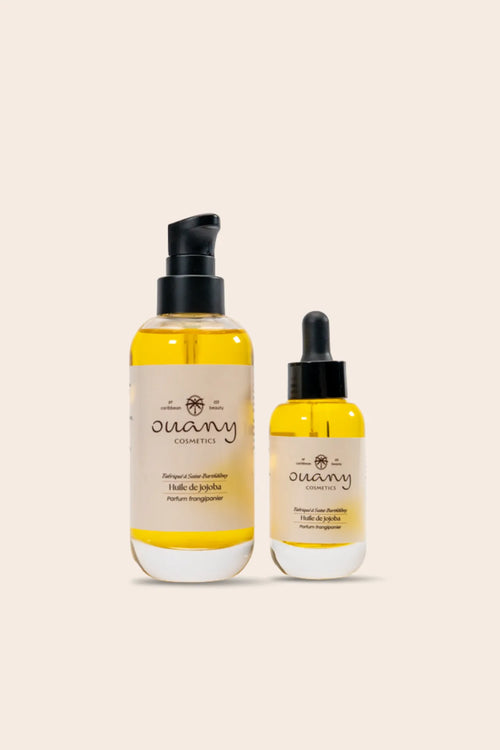
Our Ouany products
Available at our points of sale in St Barts and at our partner hotels, spas and villas.


Why is tea tree oil being classified as toxic to reproduction?
Tea tree oil is on track to be classified as toxic to reproduction because the European Chemicals Agency's Risk Assessment Committee recommended the hazard statement H360Fd. This statement flags a possible risk to fertility and a suspected risk to the unborn child. It describes an intrinsic hazard, not the risk tied to a specific use.

Hazard and risk are two different things
A hazard is a substance's ability to cause harm. Risk depends on the dose a person actually receives. The CLP Regulation classifies substances by hazard; the SCCS then assesses the risk for a specific cosmetic use.
That explains the current situation: a proposed CMR classification alongside a scientific opinion that finds some uses safe at low concentrations. The Australian industry disputes the classification, but the EU process is moving forward.
Also classified as a skin allergen
The proposed classification goes beyond reproduction. According to Critical Catalyst's summary, it also includes Category 2 skin irritation and Category 1B skin sensitization, among others.
The SCCS describes tea tree oil as a moderate skin sensitizer. A sensitizer can trigger contact allergy in some people after repeated exposure. Earlier EU scientific committees had already flagged this potential, along with a risk of skin and eye irritation.
An oil that changes with air and light
The SCCS points out that tea tree oil's composition can change with exposure to light, heat, air or moisture. During storage, p-cymene levels rise while alpha- and gamma-terpinene levels fall.
The dossier submitted to the committee contained no stability data, which the SCCS explicitly noted. Another recent signal: on July 29, 2026, the SCCS agreed to assess p-cymene, found in many essential oils, after a recommendation to classify it as a reproductive toxicant, according to the consultancy Biorius.
The UK is taking a different path
In October 2026, the UK notified the WTO of new classifications for 80 substances. According to Biorius, the UK Health and Safety Executive reached a different view from the EU on tea tree oil and is not proposing a CMR classification in Great Britain for now.
How does Ouany see essential oils from St Barts?
From St Barts, Ouany sees the tea tree oil case as a useful reminder: "natural" does not mean "no precautions needed." Essential oils are potent blends, assessed molecule by molecule. Under the Caribbean sun and heat, how you store them deserves extra attention.

Island climate and how products are stored
On St Barts, a bottle left on a sun lounger or in a parked car quickly faces intense heat and light. The SCCS notes that these two factors, along with air and moisture, can alter an essential oil's composition.
Closing a bottle after use and keeping it in the shade are simple habits that matter even more in the tropics.
Read the label before trusting the word "natural"
Ouany skincare comes in glass bottles and is formulated with more than 95% ingredients of natural origin. The range includes a jojoba oil, an aloe vera after-sun gel and a coconut-vanilla scented body lotion.
As with any cosmetic, each product's full ingredient list is printed on its packaging: that is the reference to check if you avoid a specific ingredient. Ouany products are available in shops on St Barts and at partner hotels, spas and villas.
Our tips for choosing and using tea tree oil cosmetics
To choose a tea tree oil cosmetic, look for "Melaleuca Alternifolia Leaf Oil" on the ingredient list and stick to the formats the SCCS assessed: shampoo, shower gel, face wash and face cream for adults. Avoid sprays, store products away from light and ask a professional if in doubt.

Everyday habits
- Read the INCI list: tea tree oil appears as "Melaleuca Alternifolia Leaf Oil."
- Keep in mind that the SCCS opinion covers low-concentration finished products, not pure essential oil.
- Close bottles tightly and store them away from heat and sun to limit oxidation.
- Stop using a product if you notice redness, itching or burning.
When to ask a professional
The SCCS opinion only covers adults. During pregnancy or breastfeeding, for a child, on broken skin, or if you have a skin condition such as eczema, psoriasis or seborrheic dermatitis, ask a dermatologist, your doctor or a pharmacist before using a tea tree oil product.
A reaction after applying a product is also a reason to see a professional: only a healthcare provider can identify the ingredient responsible, for example through allergy testing.
FAQ
Is tea tree oil banned in cosmetics in the EU?
No. As of November 2026, tea tree oil is still allowed in cosmetics sold in the EU. The regulation that would classify it as toxic to reproduction had still not been published in August 2026, according to the Australian industry. Once classified, it is expected to be limited to certain products and concentrations rather than banned outright.
Can I still buy a tea tree oil shampoo?
Yes, tea tree oil shampoos are still on sale. The SCCS considers tea tree oil safe at up to 2% in shampoo for adults, provided the oil meets the ISO 4730:2017 standard. The exact concentration is not shown on the label, but the ingredient is listed as "Melaleuca Alternifolia Leaf Oil."
Why does the SCCS opinion exclude children and sprays?
The SCCS only assessed the uses defended in the dossier it received, which were limited to adults and products applied to the skin. Sprays and aerosols are excluded because they expose the airways to oil droplets. For a child, ask a pediatrician or pharmacist.
Is the UK going to ban tea tree oil too?
Not for now. According to the consultancy Biorius, the UK Health and Safety Executive reached a different view from the EU and is not currently proposing a CMR classification for tea tree oil in Great Britain. UK and EU rules could therefore diverge.
What should I do if I react to a tea tree oil product?
Stop using the product right away and rinse the area with clean water. The SCCS describes tea tree oil as a moderate skin sensitizer that can cause contact allergy in some people. If the reaction persists or spreads, see a doctor or dermatologist.
Sources
- European Commission, SCCS – Scientific Opinion on Tea Tree Oil (SCCS/1681/25), final version
- COSlaw.eu – EU introduces new CMR classifications under the 24th ATP to the CLP Regulation
- Critical Catalyst – European Union notifies WTO of the draft 24th ATP to CLP Regulation
- ATTIA – EU Regulatory Update: Progress Continues as Industry Response Gains Momentum
- Biorius – Cosmetics Breaking News
- COSMILE Europe – Melaleuca Alternifolia Leaf Oil (in French)
Photos: Ouany; Kelly Sikkema, Julia Koblitz, Allec Gomes, Louis Reed and Chelsea Shapouri on Unsplash.
Read next
- Fragrance Allergens in Cosmetics: What Changed in 2026
- How to Fix Cracked Heels: Causes, Care and Tips
- How to Get Rid of Under-Eye Bags: Causes and Tips
- Does Salt Water Help Acne? The Truth About Sea Swims
- Spicules Skincare: The Natural Microneedling Alternative
- When Does Skin Become Mature? Signs and Care
Read more

Is coconut oil a good idea for intimate areas? Learn about the real risks for vaginal pH, the intimate flora and latex condoms, and the precautions to keep in mind. For any intimate symptom, a heal...
The frangipani you see in St Barts is a small tropical tree of the genus Plumeria. White-flowered Plumeria alba is native to the Lesser Antilles, while the colorful garden frangipanis mostly descen...