

Jojoba Oil Research: What Science Says
What does science actually say about jojoba oil? This plant oil has drawn researchers' attention for decades because of its unusual composition: a waxy structure often compared to human sebum and exceptional stability. Many claims circulate online, from "regulates sebum" to "anti-aging." Some describe what jojoba oil is; others go further than the evidence usually cited. Here is a careful look at what is well established, what is often claimed, and where a dermatologist's advice is worth more than any blog post.
1. A composition studied in the lab

A waxy structure close to sebum
Analyses show that jojoba oil isn't a classic oil. It is made mostly of wax esters, a family of compounds also present in human sebum. This similarity is the main reason it is described as having an affinity with skin.
Natural antioxidants
Jojoba oil contains tocopherols, natural forms of vitamin E. These molecules are antioxidants: they help protect the oil itself against oxidation.
Remarkable stability
Its resistance to oxidation is one of its best-known traits. Unlike most plant oils, it goes rancid very slowly, so it keeps its qualities for a long time when stored properly.
2. Effects on skin: what is often claimed

Moisture and the skin barrier
Like other oils, jojoba is used as an emollient: it sits on the surface of the skin and is applied over damp skin or a moisturizer. It doesn't bring water to the skin by itself.
Sebum "regulation"
You will often read that jojoba oil "tells" the skin to produce less sebum. This idea is widely repeated but is a claim, not an established mechanism. Every skin responds differently.
Calming irritation
Many people with sensitive skin say they tolerate jojoba oil well. For persistent redness or irritation, though, the right step is to see a dermatologist, not to self-treat with an oil.
3. Jojoba oil and acne

Often described as non-comedogenic
Jojoba oil is frequently classified as non-comedogenic, which is why it appears in many formulas for combination or oily skin. That label doesn't guarantee every skin will tolerate it.
Shine
Some people with oily skin like its light texture; others find it adds shine. The amount used makes a big difference.
Known limits
Applying too much can leave an occlusive film. Acne is a skin condition: if you are dealing with it, see a dermatologist, who can recommend an appropriate treatment and routine.
4. Dry and sensitive skin

Comfort
Dry skin often enjoys the soft feel of an oil applied after the shower. Jojoba is a light option among plant oils.
Texture
People commonly use it on rough areas such as elbows or hands. Results vary from person to person.
Tolerance
Jojoba oil has a reputation for being gentle, but no ingredient suits everyone. A patch test is the safest first step, especially for sensitive skin.
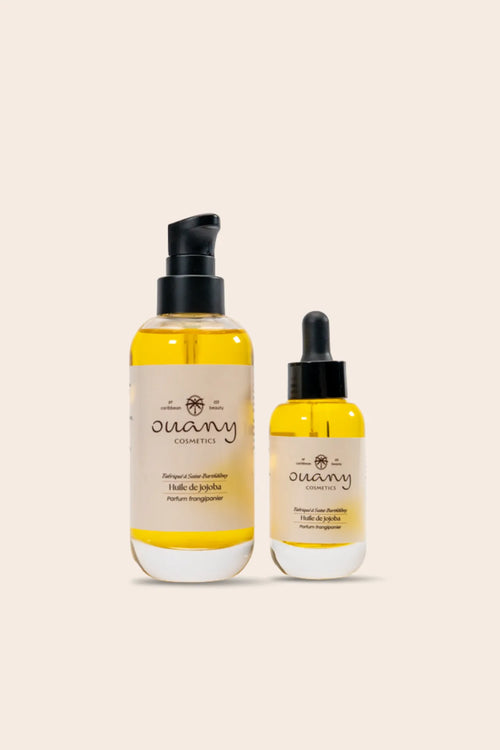
Our Ouany products
Available at our points of sale in St Barts and at our partner hotels, spas and villas.


5. Aging and antioxidants

Oxidative stress
The tocopherols in jojoba oil are antioxidants. Their presence in the oil is well documented, but that doesn't mean applying the oil will change how skin ages.
No anti-aging active
Jojoba oil is not an anti-aging ingredient. It can be part of a routine for comfort, nothing more.
Limits of the evidence
For visible signs of aging, daily sun protection and advice from a dermatologist matter far more than any single oil.
6. Scalp and hair
Scalp
Jojoba oil is often used as a pre-shampoo treatment. If your scalp is oily, flaky or itchy on a lasting basis, see a dermatologist: these signs can have several causes.
Itching
Persistent itching is not something to self-treat with oils. Get professional advice.
Softness and shine
A drop smoothed over the lengths adds slip and a subtle shine, which is why it is a classic in hair routines.
7. Documented risks and side effects

Rare but possible allergies
Allergic reactions to jojoba oil are uncommon but possible. They show up as redness or tingling. Stop using it if they appear.
Irritation depending on skin condition
Skin weakened by dermatological treatments may react more strongly. Ask your dermatologist before combining products.
Application mistakes
Many reactions come from using too much or applying it to irritated skin.
8. Practical guidance by skin type
Oily skin
A very light application is enough. Watch how your skin responds over a few days.
Dry skin
Apply it over damp skin or after a moisturizer for a more comfortable feel.
Combination skin
Many people apply it only to the drier areas of the face.
9. How to use it
Amount
A few drops are enough for the face. Too much leaves a thick film.
Application
On slightly damp skin, the oil spreads more easily and feels lighter.
Patch test
A patch test beforehand is recommended for sensitive skin.
10. FAQ
Is jojoba oil really non-comedogenic? It is commonly classified that way, but individual tolerance varies.
Does it help with acne? Acne is a skin condition: ask a dermatologist for a suitable routine rather than relying on an oil.
Is it suitable for sensitive skin? Many sensitive skins tolerate it, but a patch test comes first.
What are the risks? Uncommon allergies and possible irritation, especially with excessive use or on irritated skin.
Read next
Read more

Jojoba oil has an unusual composition and a long list of promises attached to it. This guide looks at what it is, how people use it on skin and hair, and where caution is wise.

Jojoba oil is one of the most common bases in beard oils, thanks to its light, non-greasy texture. Here is how to apply it, which mistakes to avoid, and what to keep realistic expectations about.