
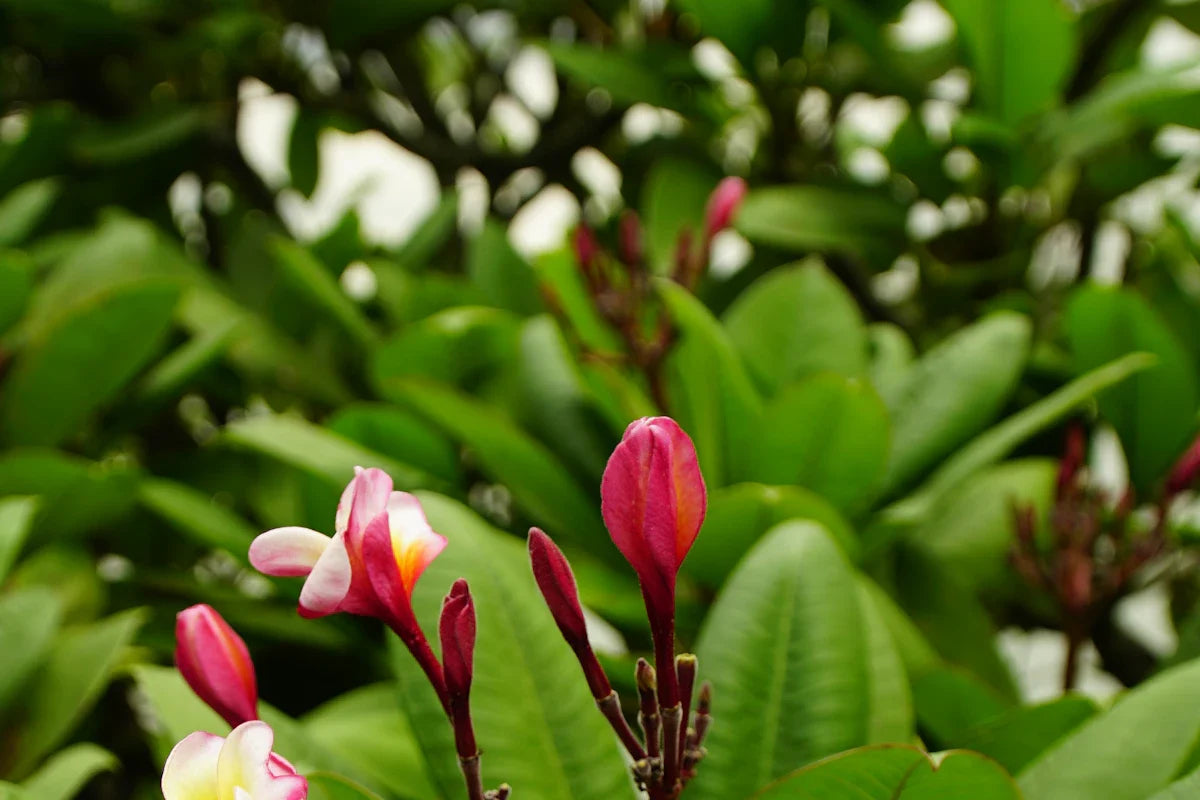
Frangipani in St Barts: Origin, Scent and Uses
The frangipani you see in St Barts is a small tropical tree of the genus Plumeria, known for its waxy, five-petaled flowers and their powerful scent. One white-flowered species, Plumeria alba, grows naturally in the Lesser Antilles, while the pink and yellow garden varieties mostly descend from Plumeria rubra, which came from Central America. The flower offers no nectar at all: it lures sphinx moths with scent alone.
Key takeaways
- According to the Royal Botanic Gardens, Kew, Plumeria alba is native from Puerto Rico to the Windward Islands, including the Leeward Islands where St Barts lies.
- Plumeria rubra, the frangipani most often planted in tropical gardens, is native to an area stretching from Mexico to Venezuela and was introduced to the Antilles, according to Kew.
- A 2019 study in Plant Physiology measured 207.6 nanograms of volatile compounds released per gram of open flower per hour, compared with 33.1 for a flower bud.
- In the same study, 70.1% of the scent compounds released by the open flower belonged to the phenylpropanoid and benzenoid family.
- Plumeria rubra flowers produce no nectar, according to the National Tropical Botanical Garden: they mimic the cues of flowers that hawkmoths usually visit.
- Since July 31, 2026, any cosmetic newly placed on the EU market must name each listed fragrance allergen present above 0.001% in a leave-on product, under Regulation (EU) 2023/1545.
Contents
- What is the frangipani tree you see in St Barts?
- Is frangipani native to St Barts and the Caribbean?
- Why does frangipani smell so strong?
- How is frangipani scent used in skincare?
- What place does frangipani hold in St Barts, as Ouany sees it?
- Our tips for enjoying frangipani in St Barts
- FAQ
What is the frangipani tree you see in St Barts?
Frangipani is a tropical tree or shrub in the dogbane family, Apocynaceae, belonging to the genus Plumeria. In St Barts, you notice it in gardens, around villas and near the coast, thanks to its clusters of fragrant flowers that appear at the tips of thick branches, often almost bare.

How do you recognize a frangipani?
The easiest way is to look at the flowers. They are tubular at the base, then open into five slightly overlapping lobes with a distinctive waxy texture. The University of Oxford's botanic garden describes Plumeria rubra flowers as usually white or tinged with pink, with yellow centers.
Another clue lies inside the stems. When a stem is cut, it oozes a milky sap called latex. Oxford notes that this sap can be an irritant and is somewhat poisonous: look at it, never taste it, and keep it off your skin.
What colors do the flowers come in?
White with a yellow heart remains the best-known look, but tropical gardens also show pink, red, yellow and two-tone flowers. The National Tropical Botanical Garden explains that this color range in Plumeria rubra comes from extensive hybridization and breeding.
Is frangipani native to St Barts and the Caribbean?
Yes for one species, no for the other. White-flowered Plumeria alba belongs to the natural flora of the Lesser Antilles, the island chain that includes St Barts. Plumeria rubra, the species most widely grown in gardens, comes from Mexico and Central America and was brought to the islands.

Plumeria alba, the Lesser Antilles species
Plants of the World Online, the database run by the Royal Botanic Gardens, Kew, places the native range of Plumeria alba from Puerto Rico to the Windward Islands. It lists the species as native to the Leeward Islands, the arc where St Barts sits, and describes it as a tree of the wet tropical biome.
Outside the Caribbean, the same source records it only in Assam, Bangladesh and Trinidad and Tobago, where it was brought in. White frangipani is part of the region's plant heritage long before it is an ornamental.
Plumeria rubra, the garden frangipani
Kew states that Plumeria rubra is native from Mexico to Venezuela, where it grows mainly in the seasonally dry tropical biome. It has been carried to a long list of places: the Leeward and Windward Islands, Puerto Rico, Cuba, Jamaica and many Pacific islands.
This is the tree you see most often in Caribbean gardens, hotels and public spaces. Its pink, red and yellow forms come from horticultural selection, which explains the range of colors from one property to the next.
| Feature | Plumeria alba | Plumeria rubra |
|---|---|---|
| Native range (Kew) | Puerto Rico to the Windward Islands | Mexico to Venezuela |
| Status in the Lesser Antilles | Native | Introduced |
| Main biome (Kew) | Wet tropical | Seasonally dry tropical |
| Flower color | White | White, pink, red or yellow depending on the form |
| Most common use | Local flora, gardens | Gardens, flower garlands, perfumery |
Why does frangipani smell so strong?
Frangipani smells so strong because its scent works as bait. The flower makes no nectar, but it releases a blend of volatile compounds that mimics the cues of flowers visited by sphinx moths, also called hawkmoths. While searching for a reward that is not there, these moths carry its pollen from flower to flower.

Pollination by deceit
Pollination by deceit is a strategy in which a plant attracts pollinators without offering any food in return. Frangipani is a long-studied example.
A 1984 study in the journal Biotropica, titled "Pollination by deceit in a mass-flowering tropical tree," showed that Plumeria rubra flowers share many traits with hawkmoth-pollinated flowers. The researchers recovered frangipani pollen from the moths' tongues, proof that the moths do visit the flowers.
The National Tropical Botanical Garden sums up the mechanism: no nectar is produced, yet the flowers mimic the scent and visual cues that normally attract these insects. Oxford's botanic garden also describes frangipani pollination as a matter of deception.
What is in a frangipani flower's scent?
A 2019 study published in Plant Physiology analyzed the volatile organic compounds, meaning the scent molecules that evaporate into the air, released by Plumeria rubra. Open flowers released the most: 207.6 nanograms per gram of fresh tissue per hour, spread across 35 compounds.
Flower buds released only 33.1 nanograms, across 24 compounds. In the open flower, 70.1% of these molecules were phenylpropanoids and benzenoids, a family of aromatic compounds, versus 20.8% terpenoids and 3.2% volatile esters.
Our Ouany products
Available at our points of sale in St Barts and at our partner hotels, spas and villas.


How is frangipani scent used in skincare?
In skincare, frangipani mostly appears as a fragrance note. It scents oils, lotions, mists and shower gels through a fragrance blend that shows up in the ingredient list as "Parfum." In Europe, allergenic substances in that blend must be named on the label above a set threshold.

From flower garlands to bottles
Long before it scented skincare, the flower became part of welcome traditions. Oxford's botanic garden reports that at least 14 million Plumeria flowers are harvested each year in Hawaii to make leis. The National Tropical Botanical Garden notes that Plumeria rubra flowers hold their color and fragrance well, which makes them prized for this use.
What do EU rules say about fragrance allergens?
A fragrance allergen is a scent substance that can trigger contact allergy in some people. The EU Cosmetics Regulation (EC) No 1223/2009 lists several of them in its Annex III, such as linalool and limonene, which turn up in many fragrance blends, natural and synthetic alike.
Commission Regulation (EU) 2023/1545, adopted on July 26, 2023, expanded that list. Each listed substance must now be named individually on the label when its concentration exceeds 0.001% in a leave-on product, such as an oil or a mist, and 0.01% in a rinse-off product, such as a shower gel.
The timeline has two steps. Products placed on the market from July 31, 2026, must carry compliant labels. Products placed on the market before that date may still be sold until July 31, 2028.
How should you read a scented product's label?
The ingredient list, known as the INCI list, runs in descending order of concentration. "Parfum" covers the fragrance blend as a whole, and regulated allergens appear under their own names, usually near the end of the list.
If you have reacted to a fragrance before, or if your skin is sensitive, broken or prone to eczema, check with a dermatologist before trying a new scented product. They can refer you for allergy testing if needed. During pregnancy or for a child, ask a healthcare professional for advice as well.
What place does frangipani hold in St Barts, as Ouany sees it?
In St Barts, frangipani belongs to the island's garden landscape and to the Caribbean imagination. At Ouany, a skincare brand born on the island, it gave its name to a scent found in a jojoba oil and a pillow mist. It also grows in a dry territory where native plants deserve protection.

A dry island where native plants matter
The St. Barthélemy Territorial Environment Agency points out that the island's native flora is adapted to dry forest and low rainfall. It also stresses that local wildlife depends entirely on these plant species.
That flora is under pressure. The Agency counts around 2,000 roaming goats on the island, each able to eat up to 15 kg of plant material a day. It also flags the arrival of non-native plants, often shipped in from Florida by boat, some of which have turned out to be invasive.
Frangipani in Ouany products
Ouany is a skincare brand from St. Barthélemy, inspired by the Caribbean and founded by Clément Baud. Its products contain more than 95% ingredients of natural origin and come in glass bottles.
The frangipani scent appears in two products: the frangipani-scented jojoba oil, in 30 ml and 100 ml, and the frangipani pillow mist. They are not sold online: you will find them at Ouany retailers in St Barts and at the brand's partner hotels, spas and villas.
Our tips for enjoying frangipani in St Barts
The best way to enjoy frangipani in St Barts is to admire it where it grows, without picking flowers or breaking branches, and to take the scent home rather than a cutting. Its latex can irritate skin, and moving plants between territories is regulated. A few simple habits are enough to keep a lovely memory.

Look, don't pick
Fallen flowers are more than enough to enjoy the scent up close. Avoid breaking branches: the latex that seeps out can be an irritant, according to Oxford's botanic garden. If it touches your skin, rinse with clean water, and see a healthcare professional if redness or discomfort persists, especially in a child.
Bring home the scent, not a cutting
Frangipani roots easily from cuttings, which can make it tempting to slip one into your suitcase. Plants travel under conditions, though. St Barts itself requires authorization to import certain plant species in order to protect its native flora, as the Territorial Environment Agency explains.
Before taking a plant anywhere, check the plant health rules of the place you are returning to. A scented souvenir raises far fewer questions: a frangipani-scented oil or mist bought at a shop on the island fits easily in a suitcase, as long as you follow the usual carry-on liquid rules.
Good habits at a glance
- Smell fallen flowers instead of picking them from the tree.
- Avoid the latex in the stems and wash your hands after handling a branch.
- Keep flowers and stems out of reach of young children and pets.
- If you plant on the island, favor the native species recommended by the Territorial Environment Agency.
- Before trying a scented product, read its INCI list, especially if you have reacted to a fragrance before.
FAQ
Does frangipani grow naturally in St Barts?
One species does. Plumeria alba, white frangipani, is native to the Leeward Islands, which include St Barts, according to the Royal Botanic Gardens, Kew. The pink, red and yellow frangipanis in gardens mostly belong to Plumeria rubra, a species native to Mexico and Central America that was introduced to the Antilles.
Is frangipani poisonous?
Its latex calls for caution. Oxford's botanic garden notes that the milky sap from cut stems can be an irritant and is somewhat poisonous. Never put it in your mouth or rub it on your skin. If a child swallows any or irritation persists, contact a healthcare professional or poison control center promptly.
Can frangipani fragrance cause an allergy?
It can, as with any fragrance. A fragrance blend may contain regulated allergenic substances, which Regulation (EU) 2023/1545 requires labels to name above 0.001% in leave-on products. If you have reacted to a fragrance before, read the INCI list and ask a dermatologist for advice before using a new scented product.
Why does the frangipani flower have no nectar?
Because it attracts pollinators by trickery. Plumeria rubra flowers mimic the scent and visual cues of flowers that hawkmoths visit without offering any reward, as the National Tropical Botanical Garden explains. A 1984 study in Biotropica recovered frangipani pollen from the tongues of these moths.
Where can you find Ouany's frangipani-scented products?
You can find them in St Barts, at Ouany retailers and at the brand's partner hotels, spas and villas. The Ouany website is a showcase and does not sell online. The frangipani scent comes as a jojoba oil, in 30 ml and 100 ml, and as a pillow mist, both in glass bottles.
Sources
- Royal Botanic Gardens, Kew – Plants of the World Online: Plumeria alba L.
- Royal Botanic Gardens, Kew – Plants of the World Online: Plumeria rubra L.
- National Tropical Botanical Garden – Plumeria rubra
- University of Oxford, Plants400 – Plumeria
- Biotropica (1984) – Pollination by Deceit in a Mass-Flowering Tropical Tree Plumeria rubra L. (Apocynaceae)
- Plant Physiology (2019) – Volatile organic compounds emitted by plumeria (Plumeria rubra) tissues
- St. Barthélemy Territorial Environment Agency – Promoting native flora
- EUR-Lex – Commission Regulation (EU) 2023/1545 on fragrance allergen labeling
Photos: Allan Wadsworth, Naoki Suzuki, Bucaioni Francois, Abhijeet Apsunde and Natasha on Unsplash; Ouany.
Read next
Read more

Tea tree oil is not banned in EU cosmetics as of November 2026, but the European Union plans to classify it as toxic to reproduction. The EU scientific committee considers it safe for adults at low...

To fix cracked heels, moisturize at least twice a day with a urea-rich cream, gently buff softened calluses and apply a thick balm at night under socks. See a doctor if the cracks bleed, become inf...